School Mathematics Improvement Program (SMIP)

Adhyayan Sanstha conducted a study to understand the glitches in learning of mathematics and science at high school level.

(0.0/ 0 )
Last Updated : April 27, 2026

Adhyayan Sanstha conducted a study to understand the glitches in learning of mathematics and science at high school level. It became evident that the topics in middle school mathematics (fraction, decimal fractions, divisibility including LCM and HCM, basic geometry – spatial vision and measurement) were not learnt properly. These topics are the basics for further learning of mathematics & science.   This was the basic reason that the students in high school had problems in learning of mathematics & science. At the high school level Adhyayan found that students faced problems in understanding and applying linear equations, quadratic equations, properties of figures like triangles, quadrilaterals, and circle. Students also faced problems with co-ordinate geometry and trigonometry. This was reflected at higher secondary level (11th and 12th).

To address this problem Adhyayan Sanstha designed the School Mathematic Improvement Program [SMIP] for middle schools in the beginning. It took one year to design a systematic program. We faced problems with intervention with schools. Looking at problems faced with school administration and resources available with Adhyayan we decided to select only one topic in details per academic term (i.e.) two topics per year. With this idea, it because 3 years’ program. Topics decided for middle schools are fraction in first term decimal fraction in the second term (year-1). Divisibility with BODMAS and number line in the 3rd term (i.e. one year-2) and basic geometry in the 4th term         (year- 2). Measurement part-Ӏ in the first term (year- 3) and measurement part-ӀӀ in the 6th term. Measurement during the 3rd year, students learn to apply all what is learnt in the previous two years.

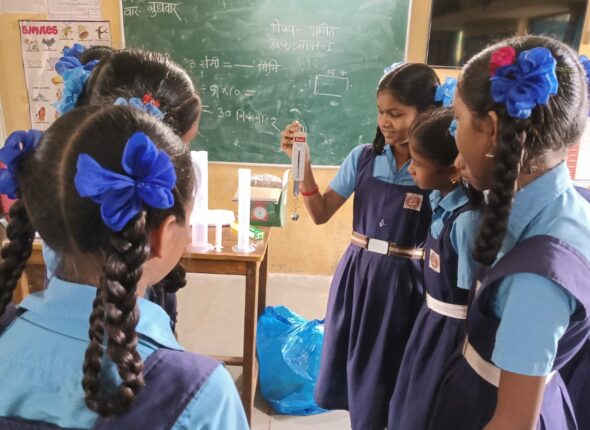
Learning only one topic per term has helped teachers to assimilate the process of teaching which allows experimental and laboratory approaches of learning. This proved to be greatly helpful to students too. Students started learning mathematics for better than earlier.

This is 6th year (we lost 2 years in between) of the SMIP primary. Topics decided for secondary schools in SMIP are
  1. Mensuration
  2. Trigonometry
  3. Circle
  4. Co-ordinate Geometry
  5. Triangles and Quadrilaterals
  6. Polynomials and Equations
For secondary schools, it is one topic per year in mathematics. The processed followed for proper working of SMIP. Step -1
  • Topic is selected
  • Teaching – Learning strategies are developed.
  • Lab books (one per schools) and workbooks (one per student) are developed.
Step – 2
  • Teacher training
  • Pre – test about the topic for all students.
Step – 3-A
  • School teachers teach in school as per their training.
  • In tribal and rural areas Adhyayan teachers go to school and teach once or sometimes twice.
Step – 3 B
  • Post – test of all students
  • 10 students from each school are selected for Olympic.
Step – 4
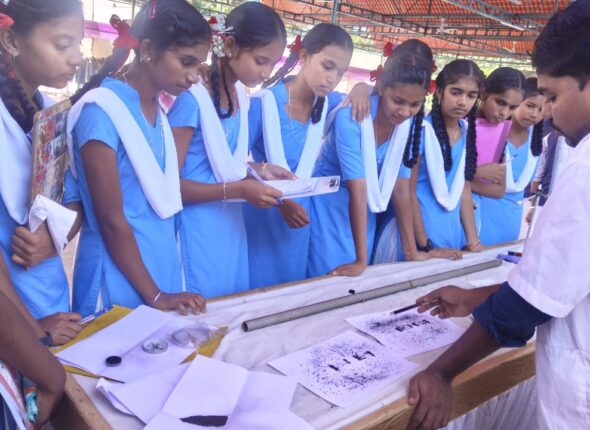
  • Olympic is a full- day gathering of selected students from 10 to 15 schools.
  • In the beginning all students give a written test which is at little higher level than their post-test. Two students from each school are selected.

A popular talk based on science or technology or mathematics is delivered to these children meanwhile checking their answer sheets papers are being checked.

The two selected students from each school then attend an open quiz. There are two rounds of this open quiz. After the final round prizes are distributed to schools and students.

There are no items in the curriculum yet.
To enroll in a course, you need to create an account on our platform, browse our course catalog, and click on the "Enroll" button next to the course you want to join. Follow the on-screen instructions to complete the registration process.
Yes, most of our courses offer a certificate of completion, provided you meet all the course requirements, such as passing quizzes and submitting assignments.
Courses often include quizzes, assignments, and sometimes final exams to assess your understanding of the material. The specific assessment methods will be detailed in the course syllabus.
Courses can be paid for using a credit/debit card, PayPal, or other payment methods specified at checkout. Payment is required at the time of enrollment.