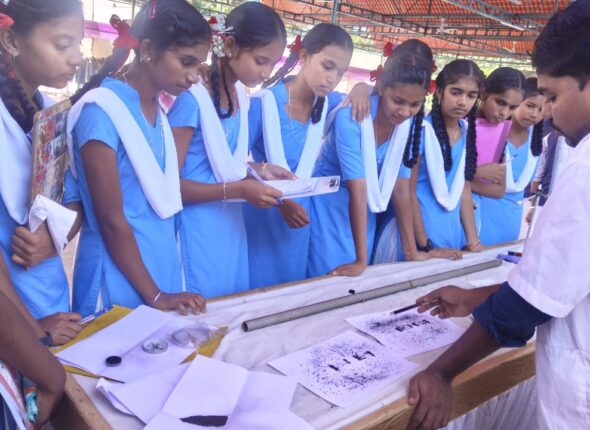
Geography Parks

Adhyayan Sanstha found that, only cultural aspects of geography are taught in schools.

We often hear about science parks and many of us may have enjoyed exploring scientific principles through such spaces. Adhyayan Sanstha conceived the idea of a Geography Park to introduce the fundamental principles of physical geography. Physical geography isoften a neglected aspect in the learning of geography because it involves a significant amount of science and mathematics.

Adhyayan Sanstha entrusted me with the responsibility of bringing the concept of the Geography Park into reality. Geomorphology, climatology, meteorology, hydrology, oceanography and biogeography are major components of physical geography.These disciplines help humankind understand how natural forces shape the environment.

Cartography and geospatial studies are also integral parts of physical geography. Since the Earth is part of the solar system, it must be studied as a planet. Therefore, planetology and the Earth–Moon relationship also become important components of physical geography.

The primary requirement for establishing a Geography Park is open land. It is a costly affair; therefore, we decided to collaborate with organizations that own land and partner with them to develop and operate the Geography Park concept.

At present, Adhyayan Sanstha has established 4 Geography Parks in partnership with:
  • Vasundhara in Kudal (Sindhudurg)
  • Snehalaya in Ahmednagar
  • Sanskruti Samvardhan Mandal in Biloli Block, Nanded
  • Sughndha Farm in Kurunze- A partner organization in Palghar

Due to land constraints, we could not implement all our ideas at every location.
Phase I Development of Geography Parks


In Phase I, the following models were developed:
  • Large-scale relief map of a district
  • Large-scale relief map of the state of Maharashtra
  • Large-scale relief map of India
  • Large-scale relief map of the world

These four large ground models enable visitors to observe major mountain ranges on land as well as features of the ocean floor. A relief model of the Great Himalayas, through which one can observe major mountain ranges, passes, and the origins of major rivers.

Relief models demonstrate watersheds, micro-watersheds, and river systems. Few Models explain major geographical terms related to landforms and water bodies.

A local meridian model with experiments help to determine true north and calculate the local longitude.

A local latitude model with experiments help to locate the Pole Star and determine the local latitude. A large globe mesh for conducting various experiments. Zero-shadow demonstration model, Simple sundial Solar eclipse demonstration model, Salt pillar model, Mushroom rock model, Challenges Faced.

There were several challenges in constructing the Geography Parks. Masonry workers and artists had no prior experience with this kind of work. At all four locations, we encountered this issue. We had to train the masonry workers and in most cases, worked closely alongside them.

Three of the existing Geography Parks (Sindhudurg, Ahmednagar and Nanded) are spread over approximately 1,500 square metre each. The park in Palghar is comparatively smaller in area.

The total annual number of visitors to these Geography Parks has now crossed 13,000, with nearly 90% being students. They enjoy learning through hands-on experiences at the parks. Educators, teachers, professors and experts have appreciated the initiative, as the Geography Parks help children clarify their concepts and develop a strong spatial
understanding.

Nilesh Todankar
Science-Geography Project Officer
Adhyayan Santha

To enroll in a course, you need to create an account on our platform, browse our course catalog, and click on the "Enroll" button next to the course you want to join. Follow the on-screen instructions to complete the registration process.
Yes, most of our courses offer a certificate of completion, provided you meet all the course requirements, such as passing quizzes and submitting assignments.
Courses often include quizzes, assignments, and sometimes final exams to assess your understanding of the material. The specific assessment methods will be detailed in the course syllabus.
Courses can be paid for using a credit/debit card, PayPal, or other payment methods specified at checkout. Payment is required at the time of enrollment.
EDUBIN0073
EDUBIN0095
EDUBIN0096